

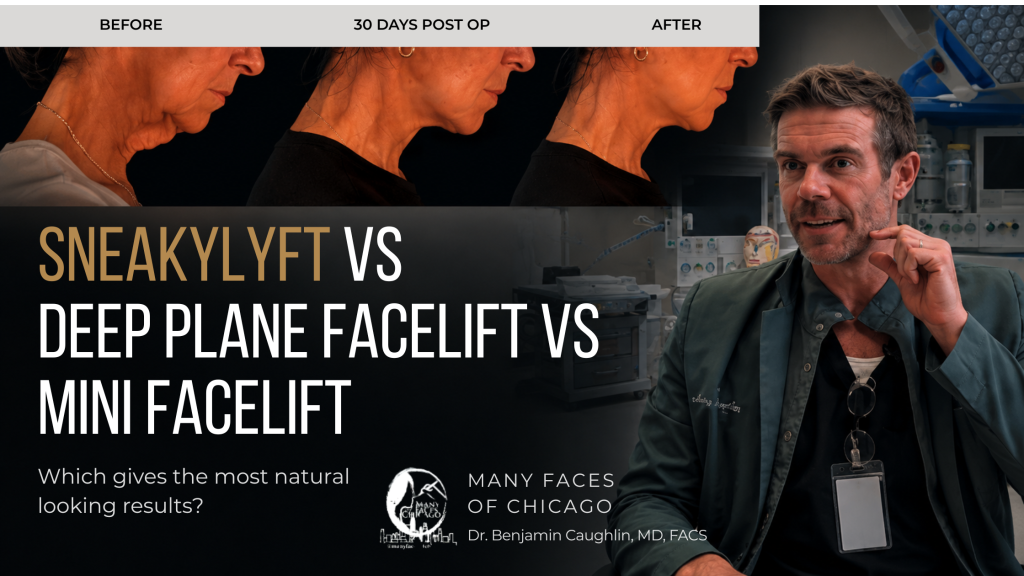
Mini Facelift, Deep Plane Facelift, or SneakyLyft: Dr. Caughlin’s Honest Take
People say, look pretty good — but my jowls, my neck, oh my God, Doc, it just bugs me so much.Those are the people who see me.
— Dr. Benjamin Caughlin, Many Faces of Chicago
The biggest difference between the SneakyLyft ℠ and a mini facelift or deep plane facelift is it focuses primarily on the neck and jawline.
Why? Because the lower thirds of your face can age threefold compared to your upper and middle thirds (think facial features above your mouth). With the Sneaky Lyft, a millimeter adjustment, although subtle, can make a significant difference.
“The other beautiful thing of the jawline and the neck, it can’t be too tight. No matter how tight you get the jawline, it never looks goofy. No matter how tight you get the neck, it never looks goofy.” – Dr. Benjamin Caughlin, Many Faces of Chicago
So if you’re considering a Sneaky Lyft, here’s a quick rundown of what each procedure has to offer.
Quick Comparison: Three Procedures at a Glance
Procedure | Focus Area | Best Candidate | Longevity | Recovery |
Mini Facelift | Lower face, early jowls | 40s–early 50s, mild skin laxity | 3–5 years | 1–2 weeks |
Deep Plane Facelift | Full face — midface, neck, cheeks | Moderate to advanced aging, full-face concerns | 10+ years | 3–6 weeks |
SneakyLyft ℠ | Jawline and neck — structural level | Primary concern: lower third — jowls, neck, jaw definition | Structural baseline — built to outlast surface lifts | Variable — discuss at consultation |
What a Mini Facelift Actually Does
The mini facelift is the least invasive of the three, and that is both its strength and its limitation.
It works by tightening the SMAS (the superficial musculoaponeurotic system), a layer of muscle and connective tissue just beneath the skin. Surgeons place small incisions near the ear and typically perform the procedure under local anesthesia or light sedation.
Recovery runs about one to two weeks. For someone in their early 40s with mild jowling and minimal skin laxity, it produces a visible, natural-looking result.
The catch is longevity.
Because a mini facelift addresses the SMAS superficially, tightening without releasing the deeper structures underneath — the underlying causes of aging continue to progress.
Most patients see results fade within three to five years. For some, that tradeoff makes sense. For others, it means returning for revision sooner than expected.
What a Deep Plane Facelift Does
The deep plane goes further… literally.
Rather than working on the SMAS from above, the deep plane facelift releases and repositions the tissue below it. This means addressing sagging cheeks, deep nasolabial folds, and significant neck laxity in a single procedure. The results are more comprehensive and longer-lasting, typically a decade or more, and when done well, they look natural.
However, the deep-plane facelift is limited.
The deep plane targets full-face rejuvenation, which means it moves across the midface and periocular area as well as the lower third. In the right hands, that is appropriate. But when a surgeon overextends into the cheeks or around the eyes, even by a small margi, results can begin to look off.
“You get into the mid-cheeks, you can start to look really weird. You open up the eyes too much, people get a surprise look. From the mouth up, a millimeter too much starts making people look like a cat.”
— Dr. Benjamin Caughlin
That overcorrection risk is a primary clinical critique of the deep plane, and it is the problem the SneakyLyft is specifically designed to avoid.

What the SneakyLyft ℠ Facial Procedure Does Differently
Dr. Benjamin Caughlin developed the Sneaky Lyft Proecure at Many Faces of Chicago after observing the same pattern repeatedly in his Chicago practice.
Patients continued to come in, primarily bothered by their jawline and neck, rather than their entire face. They looked fine overall. It was the lower third that had changed. A procedure designed to address everything was not what they needed.
“The reason the lower third ages disproportionately to the upper and middle thirds is threefold — the bones get smaller, there’s atrophy of the superficial fat bed, and there’s separation of the musculature. The SneakyLyft targets it from all three of those levels.”
— Dr. Benjamin Caughlin
That three-level approach is what sets the Sneaky Lyft apart structurally, as explained by Dr. Benjamin Caughlin below:
Quick Recap: Sneaky Lyft vs Deep Plane Facelift vs Mini Facelift
Longevity. The SneakyLyft creates a structural baseline. Results hold longer because they’re built into the bone, muscle, and soft tissue, not borrowed from skin tension alone.
Candidacy. The mini facelift suits early-stage concerns in the 40s; the deep plane suits moderate to advanced full-face aging; the SneakyLyft is built for patients whose primary complaint is the jawline and neck.
Overcorrection risk. Because the SneakyLyft stays focused on the lower third, it avoids the overcorrection risks that can occur when the midface and periocular area are over-treated, even by a millimeter.
Mechanics. A mini facelift works at the surface; deep plane moves across a broader zone, and the SneakyLyft targets the structural causes of lower-face aging specifically.
Technique. SneakyLyft corrects neck banding and restores jawline definition through vertical midline platysmaplasty (reposition the platysma muscle), lifting it upward and back at the same time
Augmentation. In select cases, Dr. Caughlin also uses subtle mandibular augmentation, as little as a millimeter, to restore the bone projection that the jawline loses with age.
“Think Angelina Jolie, Sofia Vergara, Henry Cavill, Michael Jordan, Kerry Washington, really good jawline. Those people are never gonna get lifts because they have that big, nice bone structure.
And that’s the key. I’m putting the muscle in the position that we want it. I’m giving a little bit of augmentation to the bone.” – Dr. Benjamin Caughlin, Many Faces of Chicago
How to Know Which One Is Right for You
The right procedure depends entirely on what is actually bothering you.
Get a Mini Facelift If…
You are in your early 40s, the changes are mild, and you want a shorter recovery with a lower surgical commitment; a mini facelift may be worth discussing. It will not deliver structural longevity, but it is a reasonable option for early-stage concerns.
Interested in seeing if a Mini Facelift is right for you? Read more about it here.
Get a Deep Plane Facelift If…
You have moderate to advanced aging across the full face, including sagging cheeks, deep folds, and significant neck laxity. If you want comprehensive results that last, a deep plane is worth a serious conversation. Find a surgeon with a track record specifically in deep plane technique, and ask directly how they handle the midface and periocular area.
Ready for a deep plane facelift? Here are all the details and what to expect.
Get a Sneaky Lyft If…
Your jawline and neck are the primary concern. The SneakyLyft is built for that.
Most patients who find their way to Many Faces of Chicago are not bothered by their whole face. They have a specific complaint, jowls, a softening jawline, a neck that aged faster than the rest of them. The SneakyLyft targets that concern at the structural level and leaves the rest alone. Chicago-area patients increasingly choose it precisely because it delivers where the problem is without touching what is not broken.
If you need more information about SneakyLyft, we’ve compiled a guide on its key differences.
Can’t Decide Which Facelift Gives You the Most Natural Results?
“Find what bugs you, find a surgeon who focuses on it, then go do your consult. See how they can get you the happiest, with the least amount of surgery possible. That’s really my goal.”
— Dr. Benjamin Caughlin, Many Faces of Chicago
A SneakyLyft consultation with Dr. Caughlin at Many Faces of Chicago is the most direct way to find out which procedure fits your situation. He assesses every patient on a case-by-case basis to inform you about the most suitable method for your unique anatomy and objectives, or if none of the options are appropriate at this time.
Last Updated on June 8, 2026 by Dr. Benjamin Caughlin – Facial Sculpting Surgeon Chicago