

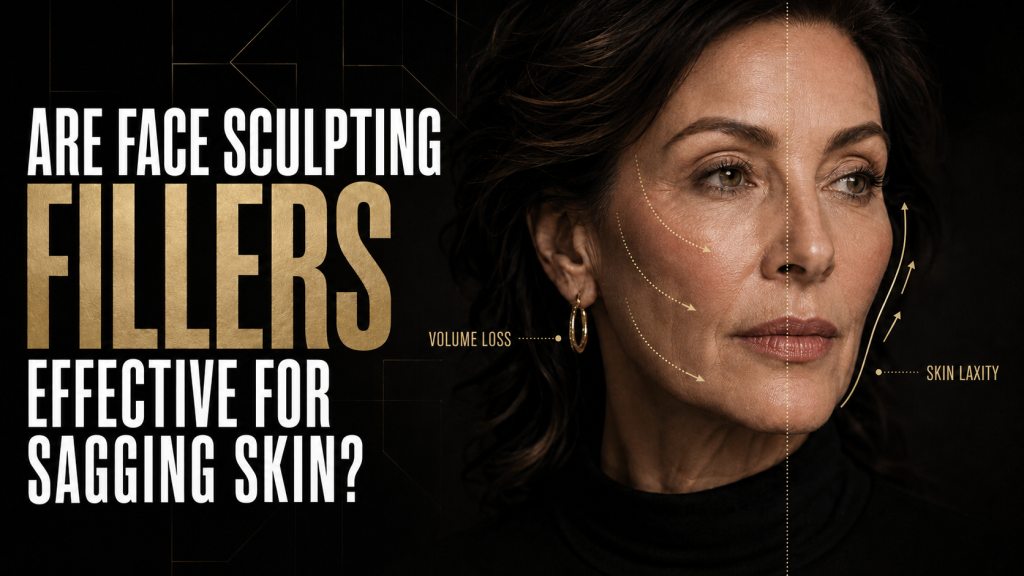
Face sculpting fillers work, but only on a specific kind of sagging. When skin droops because the face has lost volume underneath it, filler puts that support back and the sagging visibly lifts.
In 2024, ASPS surgeons performed 5,331,426 hyaluronic acid filler treatments and 79,058 facelifts. That’s 67 syringes for every lift. Some of those syringes went into faces that needed them. Plenty went into faces where the sagging had nothing to do with volume at all. Here’s how to tell which one you’re looking at.

When Should You Choose Fillers to Treat Sagging Skin
Face sculpting fillers work well on sagging caused by volume loss. That includes hollow cheeks, a flattening midface, a jawline losing its underlying structure.
However, they do almost nothing for sagging caused by loose, stretched skin because fillers add volume, but can’t lift skin.
To give you a little more context…
Two patients can say the same thing: “my jawline looks tired” and mean two different problems.
- One’s cheeks and jawline have simply thinned, so lying flat changes almost nothing; filler rebuilds what’s missing.
- The other’s jawline sharpens lying down, because gravity (not lost volume) is pulling it south, and no filler fixes that.
Two completely different problems. Opposite treatments.
“Deflation requires filling. Skin that’s loose needs lifting. Confusing them is the single most expensive mistake in aesthetics.”
The Lie-Down Test (Do It Tonight)
Here’s a two-minute check you can do right now: Lie flat on your back, hold a mirror above your face, and look.
Did your jawline suddenly reappear? Then gravity is your problem, and gravity doesn’t respond to volume.
Did your face look more or less the same as it does standing up? Then you’re deflating, and filler is genuinely built for that.
| What you see | What it means | What it responds to |
|---|---|---|
| Hollow temples, flat cheeks, dark under-eyes | Deflation | Fillers |
| Jawline transforms lying down | Descent | Lifting procedures |
| Skin pinches loose and settles back slowly | Skin laxity | Lifting, threads, or energy-based treatment |
| Honestly? A bit of everything | Combination | A staged plan, in the right order |
Most faces past 45 land in that last row. Which is exactly why the order of operations matters more than the product list.

Why Adding More Filler Stops Working
Fillers were never approved to lift lax skin, and reading the actual FDA indications makes that unmistakable.
The approved uses are wrinkles, skin folds, and “augmentation (increased volume) of lips, cheeks, chin, and back of the hand.” The American Society of Plastic Surgeons says it outright: if you have jowls or loose excess skin, fillers “can’t effectively address that completely.”
What happens when you push past that line anyway:
- Volume has WEIGHT. Every syringe into a descending face hands gravity more to pull on.
- You widen before you lift. Big-volume sessions broaden the midface rather than sharpen it.
- Each round does less. Diminishing returns are the clinical tell; practitioners call it filler fatigue.
Back to that 67-to-1 ratio for a second. It isn’t evidence that filler is overused. It’s evidence that filler is easier: no downtime, no decision, no commitment. And easy is a fine reason to choose something, right up until it stops working.
Where Many Faces of Chicago Draws the Line
Dr. Benjamin Caughlin is a double board-certified facial plastic surgeon. He directs Facial Plastic Surgery, Facial Trauma and Scar Management at Stroger Cook County Hospital, and teaches at the University of Illinois Department of Head and Neck Surgery. His published position on when to stop reaching for injectables is refreshing:
“Most people don’t need to tear down the whole house to fix the kitchen.” — Dr. Benjamin Caughlin, on the SneakyLyft℠
That cuts both ways, and that’s the point. Sometimes filler IS the kitchen fix. Sometimes the foundation moved, and no amount of new cabinetry is going to hide it.

What Many Faces of Chicago Uses When Filling Isn’t the Answer
Once skin laxity is running the show, treatment has to move tissue instead of adding to it.
That doesn’t automatically mean you have no options left or that surgery is the only answer. More often than not, there are plenty of non-surgical options.
The practice runs a graded menu of jawline sculpting and contouring options, matched to what’s actually causing the problem:
| If the issue is | The option | What it actually does |
|---|---|---|
| Early jowls, softening jawline, neck laxity | SneakyLyft℠ | Preservation-style lift with selective deep-plane repositioning; incisions hidden behind the hairline or under the chin |
| Mild laxity, not ready for surgery | PDO thread lift | Lifts and tightens jawline, jowls, neck and lower face while stimulating collagen |
| Full lower-face and neck descent | Preservation Facelift or neck lift | Repositions deeper tissue; vertical platysmaplasty handles neck banding |
| Fullness blurring the jawline | Cheekago™, buccal fat sculpting, neck and chin liposculpting | Takes away what’s hiding your definition instead of adding to it |
| Weak chin projection reading as a soft jaw | Chin augmentation | Builds the skeletal support the jawline never had |
| Volume loss you’re tired of re-buying | FaceBBL fat transfer | Your own fat, instead of a syringe every twelve months |
| Surface laxity and skin quality | Microneedling, Morpheus8, FaceTite, ThermiTight, Vaser | Collagen and elastin stimulation, radiofrequency tightening |
The SneakyLyft℠ is the anchor for most real lower-face laxity.
Anesthesia runs from fully awake to twilight to general, and most patients are socially presentable inside one to three weeks. The candidacy test is anatomy and patients range from their twenties upward.
When volume loss and laxity show up together, structure usually goes first and dermal fillers come after, for refinement. Filling a face that’s about to be repositioned means paying for a product that gets moved anyway.
Are There Alternative Fillers?
Not every filler is built for structure. The soft ones made for fine lines vanish into a heavy lower face without changing a thing. The ones that move the needle are firm, placed deep, and used to rebuild contour.
Typically, fillers are separated into three categories, as shown below:
| Category | What Many Faces uses | What it does for sagging | What it won’t do |
|---|---|---|---|
| HA volumizers | Juvéderm, Restylane | Rebuilds midface and jawline support so skin drapes better | Lift anything that has descended |
| Collagen biostimulators | Sculptra, Radiesse | Prompts your own collagen over months; slow to arrive, slow to leave | Tighten skin that lost its elasticity |
| Long-lasting collagen filler | Bellafill | Durable structural correction in selected areas | Reposition a jowl |
Now, the biostimulators are playing a different game entirely. Instead of sitting there as volume, Sculptra triggers your own collagen to rebuild over several months,and in its FDA trial, 94% of patients still showed improvement at two years.
If you feel fillers are the ideal method of treatment for you right now, it’s worth booking a consultation first for a proper assessment. You lose more not knowing what options you have on the table.
Frequently Asked Questions
Can filler lift jowls?
Filler can improve the appearance of early jowling by rebuilding jawline definition and restoring midface support above it. That said, it cannot lift the jowl itself, because a jowl is descended tissue, not missing volume.
What is the best filler for sagging skin?
If the sagging is volume-driven, HA volumizers like Juvéderm and Restylane rebuild midface and jawline support, while biostimulators like Sculptra and Radiesse work more slowly by prompting your own collagen. If the sagging is laxity-driven, there is no best filler. The answer is a lift.
How do I know when I’ve had too much filler?
Three signals: your face reads wider rather than sharper, results fade faster than they used to, and each session does less than the one before. A provider who suggests pausing instead of adding is usually reading your anatomy correctly.
Is a liquid facelift the same as a facelift?
No, and this is what most people get confused about. A liquid facelift adds volume to camouflage descent; a surgical lift repositions the tissue that descended. Different mechanisms, different durations, different candidates.
How long do face sculpting fillers last?
Hyaluronic acid generally runs six months to a year, calcium hydroxylapatite around a year, and poly-L-lactic acid two years or more.
The Only Question Worth Answering First
Filling and lifting are both good answers. They’re just answers to different questions, and the bathroom mirror is a terrible place to figure out which question you’re asking.
A consultation at Many Faces of Chicago (224 W Hill St, Suite 500) settles it with photographic and cephalometric ( facial measurement) assessment rather than guesswork. You find out whether you’re dealing with volume, laxity, or both before committing to either path.
Want the longer version of the surgical side? Dr. Caughlin’s team covers why patients move from fillers to facial surgery and what a facelift actually repositions. For a direct consult, or for more inquires you can reach Many Faces of Chicago via our contact page or give us a call at 312-335-2070.
Last Updated on August 17, 2026 by Dr. Benjamin Caughlin – Facial Sculpting Surgeon Chicago